

In laboratory experiments, precision and accuracy are key to obtaining reliable results. Well plate templates, especially for 96 well plates, are vital tools for organizing samples, reagents, and controls. However, even seasoned researchers can make simple mistakes when using these templates, leading to costly errors and compromised data.
In this article, we will explain the common mistakes researchers make when using well plate templates and offer practical advice on how to avoid them. Even if you are conducting high-throughput screening, PCR, or ELISA, this guide will ensure you optimize your workflow and avoid the pitfalls that could hinder your experiment’s success.
What is a Well Plate Template?
A well plate template is a standardized map used in laboratory experiments to organize samples in a multi-well plate. The most common type is the 96-well plate, which contains 8 rows (labeled A–H) and 12 columns (labeled 1–12), resulting in a total of 96 wells. These templates are essential for tracking which sample goes into which well, ensuring proper organization and preventing mix-ups.
Key Uses of Well Plate Templates:
- Sample organization: Helps scientists keep track of each sample and its corresponding data.
- Consistency in experiments: Ensures that all experimental variables are correctly placed in designated wells.
- Reproducibility: Accurate templates allow others to replicate the experiment using the same setup.
Researchers use templates to design their experiments, ensuring that each well is filled with the appropriate reagents, samples, or controls. The template’s map enables easy referencing during the experiment and when analyzing results.
Why Well Plate Templates are Crucial for Laboratory Accuracy
| Mistake Name | Description of Error | Experimental Impact | Prevention Tip | Relevant Application (e.g. HTS, PCR) | Corrective Action (Inferred) |
| Mislabeling Wells | Incorrectly labeling a well or recording the wrong sample in a specific well position. | Leads to invalid experimental results due to untrackable samples and loss of data integrity. | Double-check well labels before starting and use automated software or digital templates to track them. | HTS, PCR, ELISA | Re-map data by cross-referencing remaining sample volumes; repeat the assay if data-to-sample integrity is lost. |
| Incorrect Plate Orientation | The well plate is not aligned correctly with the template (e.g. rotated 180 degrees). | Risk of misplacing samples and reagents, leading to cross-contamination or missing data points. | Verify plate orientation using visual checks or automated software to ensure alignment before loading. | HTS, PCR, ELISA | Identify true orientation via asymmetrical plate markers and computationally rotate the data map if the error is consistent. |
| Edge Effects | Samples in the outermost wells behave differently than those in the centre of the plate. | Inconsistencies in data and uneven results due to temperature gradients or evaporation variations. | Use buffer/media-filled wells at the edges and optimise incubation conditions for even temperature distribution. | HTS, PCR, ELISA | Apply statistical correction factors to edge wells or exclude edge wells from the final dataset during analysis. |
| Overloading or Underloading Wells | Failing to load each well with the precise required volume of liquid. | Overloading causes overflows; underloading results in weak reactions, failed assays, or inaccurate results. | Use calibrated pipettes, follow volume control guidelines, and use templates that include volume markers. | HTS, PCR, ELISA | Normalize data against a reference control or discard wells where overflow/evaporation compromised concentrations. |
| Failing to Update Templates | Using outdated templates that do not reflect changes in protocols, reagents, or sample sets. | Leads to confusion, errors in sample tracking, and lack of consistency across experiments. | Regularly update templates to ensure they remain aligned with current experimental goals and new protocols. | HTS, PCR, ELISA | Manually audit experimental notes against the template used and update the digital record to reflect actual protocols. |
| Using Wrong Plate Type or Format | Using a template that does not match the physical plate format (e.g. using a 96-well template for a 24-well plate). | Mismatch in experimental needs and volume requirements, leading to organizational failure. | Confirm the plate format (e.g. 6-well, 24-well, 96-well) matches the requirements before selecting a template. | HTS, PCR | Transfer samples to the correct plate format if stability allows, or restart with a compatible template. |
Without a well plate template, it would be easy to misplace samples, confuse wells, or skip essential controls. The accuracy of laboratory experiments depends heavily on correctly labeling and placing samples in their respective wells. Well plate templates eliminate these risks by providing a visual map to guide the placement of samples and reagents.
For example, when performing high-throughput screening, where hundreds of samples may be tested at once, well plate templates become indispensable. They ensure that each well is correctly filled, reducing the chances of human error. Similarly, in PCR or ELISA, where sample placement is critical for accurate readings, templates are vital for avoiding costly mistakes.
Benefits of Well Plate Templates:
- Reduces the chances of human error
- Increases experimental reliability and reproducibility
- Saves time and effort by providing a clear, organized structure
Common Mistakes When Using Well Plate Templates
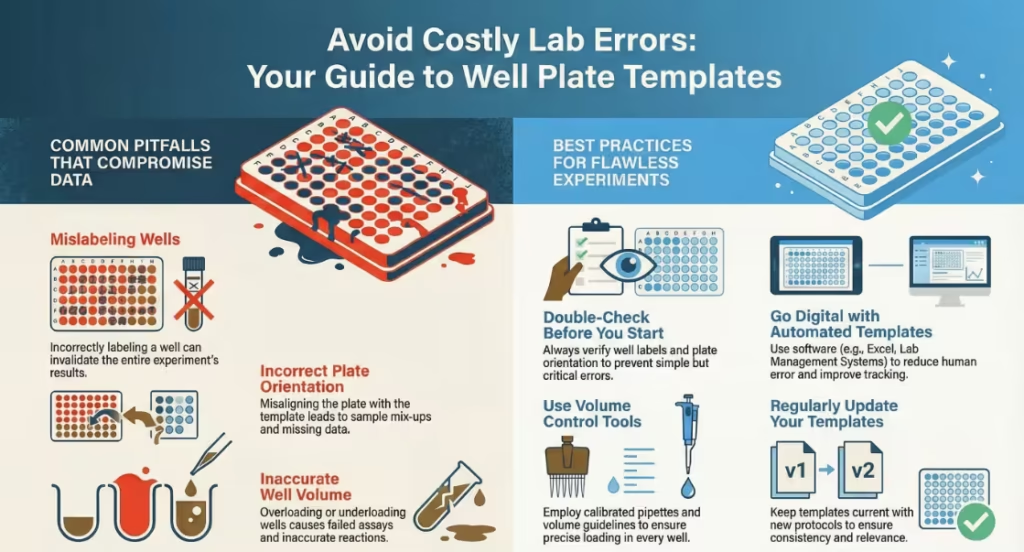
Mistake 1: Mislabeling Wells
One of the most common mistakes when using well plate templates is mislabeling wells. Since most experiments involve placing multiple samples in different wells, incorrectly labeling a well can lead to disastrous consequences. If the wrong sample is placed in a well that is recorded incorrectly, the entire experiment’s results may be invalid.
Mistake 2: Incorrect Plate Orientation
Another common mistake is using the wrong orientation for the well plate. If the plate is not aligned correctly with the template, you risk misplacing samples and reagents. This can lead to cross-contamination or missing data points.
Mistake 3: Overloading or Underloading Wells
Accurately loading each well with the right volume is critical. Overloading or underloading wells can lead to inaccurate results. For example, too much liquid may cause wells to overflow, while too little liquid may result in weak reactions or failed assays.
How to Avoid These Well Plate Template Mistakes
Tip 1: Double-Check Well Labels and Orientation Before Starting
The first step to preventing mistakes is to verify everything before you begin. This includes checking the well labels and confirming that the plate is oriented correctly. Use both visual checks and automated software to ensure everything aligns perfectly. In labs that conduct high-throughput screening or large-scale experiments, this step is crucial to avoid major errors later on.
Tip 2: Use Automated Templates for Accuracy
Digital well plate templates can help prevent common errors like mislabeling or misplacing samples. By using software to generate and track templates, you can automate many of the processes involved in sample organization. These templates allow for easy updates, tracking, and adjustments, significantly reducing the chance of human error.
Tip 3: Use Volume Control Tools and Guidelines
Accurate volume control is essential for experiments. Many templates now include volume guidelines, or you can use tools to ensure each well receives the correct amount of liquid. Ensuring that you use a calibrated pipette and adhere to the proper volume for each well is essential for accurate, reliable results.
Tip 4: Verify Plate Type and Format Before Use
Well plate templates are not one-size-fits-all. Different experiments require different plate formats, such as 6-well, 24-well, or 96-well plates. Before using a template, confirm the plate format matches your experiment’s needs. For example, high-throughput screening often requires 96-well plates, while PCR experiments might use 24-well plates.
Tools and Resources for Using Well Plate Templates Effectively
Template Software and Tools
Using the right software and tools for well plate templates can significantly enhance the accuracy of your experiments. Several digital tools are available to help researchers design, manage, and track their well-plate templates more efficiently. These tools provide templates for different well plate formats, as well as features to automate data entry and reduce errors.
Key Software and Tools:
- Excel Templates: Many researchers use Excel to create customizable well plate templates. Excel allows you to input data, track sample placement, and even automate volume calculations.
- Lab Management Software: Platforms such as LabArchives and Thermo Fisher’s Thermo Scientific™ Lab Management Software allow users to create and share digital templates. These tools often integrate with other lab equipment and provide real-time updates.
- Free Online Templates: Websites like 96 WellPlateTemplate offer downloadable templates for various well plate formats. These templates are available in different file formats such as PDF, Word, and Excel, making them versatile and easy to use.
Benefits of Using Template Software:
- Automates data entry and tracking, reducing human error.
- Makes it easier to manage large-scale experiments and high-throughput screening.
- Offers real-time updates and changes, allowing for more flexibility during experimentation.
- Provides digital templates that are easy to share and collaborate on with other team members.
Popular Tools for Well Plate Template Management:
- Thermo Scientific™ Lab Automation: Streamlines the design and tracking of well plate layouts.
- LabArchives: Digital lab notebook for organizing experiments and creating custom templates.
- Microsoft Excel: A flexible and customizable tool for creating well plate templates with built-in calculations for sample volumes.
Template Best Practices for High-Throughput Screening
High-throughput screening (HTS) is an essential technique used in drug discovery, genomics, and many other fields. It involves testing a large number of compounds or samples simultaneously, often using 96-well plates or larger formats. Ensuring that the well plate templates are accurate and easy to follow is essential for the success of HTS.
Challenges in High-Throughput Screening:
- Handling Multiple Samples: HTS involves processing hundreds or even thousands of samples. Keeping track of each sample’s placement and data is essential to avoid mix-ups.
- Minimizing Human Error: With the sheer volume of samples in HTS, human errors like mislabeling or misplacing samples can easily occur, leading to incorrect results and wasted resources.
Best Practices for Using Well Plate Templates in HTS:
- Automate the Process: Use digital templates and lab management software to automatically track the placement of each sample in the well plate.
- Double-Check Labels and Data: Always review your template before starting the experiment to ensure that labels match the sample data.
- Use Controls: Set aside wells for control samples and blank wells to help identify any inconsistencies in the data.
- Leverage Barcoding Systems: For larger experiments, consider using barcodes to track each sample’s placement. This can be integrated with well plate templates to ensure that data is correctly linked to the corresponding sample.
By following these practices, researchers can significantly improve the efficiency and accuracy of HTS experiments, ensuring reliable results without spending excessive time or resources on manual checks.
FAQs
What are well plate templates used for in laboratory research?
Well plate templates are used to organize and track samples in multi-well plates. They provide a transparent and standardized layout, ensuring that each sample, reagent, and control is placed in the correct well. This helps reduce the chance of human error, improving the accuracy and reproducibility of laboratory experiments.
How do I choose the right well plate template for my experiment?
Choosing the right well plate template depends on the plate format you’re using and the specific needs of your experiment. For example, a 96-well plate template is commonly used in high-throughput screening, while a 24-well plate might be used for smaller-scale PCR experiments. Ensure the template format matches your plate size and the experiment volume.
What is the most common mistake when using well plate templates?
One of the most common mistakes is mislabeling the wells. If the wells are not correctly labeled, it becomes impossible to track the samples, leading to incorrect experimental results. Double-checking labels before starting the experiment is essential to avoid this error.
Can digital well plate templates be more accurate than paper ones?
Yes, digital well plate templates can be more accurate than paper ones. Digital templates enable easy editing, tracking, and sharing, and can be integrated with other laboratory management software to prevent errors. They also reduce the likelihood of mislabeling or misplacement, which are common issues with paper templates.
How can I prevent edge effects in my well plate experiments?
Edge effects occur when samples placed in the outermost wells of the plate behave differently than those in the center. To prevent edge effects, you can:
- Use buffer wells or extra wells at the edges to absorb excess liquid.
- Optimize your incubation conditions to ensure even temperature distribution across the plate.
- Consider using 384-well plates or other high-density plates to reduce the impact of edge effects.
Maximizing Efficiency and Accuracy with Well Plate Templates
Well plate templates are simple yet powerful tools that can significantly enhance the efficiency and accuracy of laboratory work. By organizing your samples, reagents, and controls, you set a clear structure that ensures your experiment proceeds without costly mistakes. Whether you’re conducting PCR, ELISA, or high-throughput screening, understanding the best practices for using these templates will allow you to maintain a high level of precision.
How Digital Well Plate Templates Can Revolutionize Your Workflow
One of the most significant improvements you can make is transitioning from paper-based templates to digital solutions. Digital templates offer several advantages, including:
- Real-Time Editing: You can make changes to your template instantly, which is particularly useful if you need to adjust your experiment setup.
- Automated Tracking: Digital templates can be linked with lab management software, which automatically tracks and updates well placements, reducing the chances of human error.
- Collaboration: Digital templates can be easily shared with other researchers or team members, ensuring everyone is on the same page regarding sample organization.
By adopting digital solutions, you’re not just avoiding mistakes, you’re optimizing your workflow, saving time, and reducing the stress of manual processes.
Regular Template Updates: The Key to Long-Term Success
One of the most often overlooked aspects of using well-plate templates is ensuring they are regularly updated. Each experiment is unique, and new protocols, reagents, or sample sets may require adjustments to your well-plate layout. Failing to update your template for each experiment could lead to confusion and errors down the line. By keeping your templates up-to-date, you’ll ensure your experiments run smoothly and consistently.
Key Benefits of Updating Templates Regularly:
- Relevance: Templates remain aligned with your current experimental goals, ensuring they are fit for purpose.
- Flexibility: Regular updates enable adjustments in response to new scientific advances or changes in protocols.
- Consistency: Keeping templates updated ensures that each experiment follows the same structure, making it easier to compare results across experiments.
Final Takeaways for Improving Well Plate Template Use
To sum up, well plate templates are essential tools for ensuring that experiments are organized, efficient, and error-free. By recognizing the common mistakes associated with their use and following the tips and guidelines provided in this article, you can significantly reduce the likelihood of errors and improve the quality of your results. Whether you use digital or paper templates, taking the time to prepare, label, and track samples correctly will make your experiments more reproducible and reliable.
Key Steps to Remember:
- Double-check labels and orientation: Always ensure your well plates are correctly labeled and oriented before starting an experiment.
- Avoid overloading or underloading wells: Stick to the recommended volume for each well to ensure accurate results.
- Use automated digital templates: These can save time, reduce errors, and increase overall workflow efficiency.
- Regularly update your templates: Keep templates relevant and flexible to accommodate new experimental needs.
Conclusion: Take Control of Your Research with Well Plate Templates
Mastering the use of well plate templates is a crucial step in ensuring the accuracy and reliability of your laboratory experiments. By avoiding common mistakes, using the right tools, and keeping templates up to date, you can significantly enhance the quality of your results.
Remember, the key to successful research is organization and precision. By applying the tips outlined in this article, you’ll be well on your way to optimizing your well plate template usage and achieving reliable, reproducible outcomes in your experiments. Whether you’re working in high-throughput screening, PCR, or other assay methods, well plate templates are your ally in maintaining data integrity.