
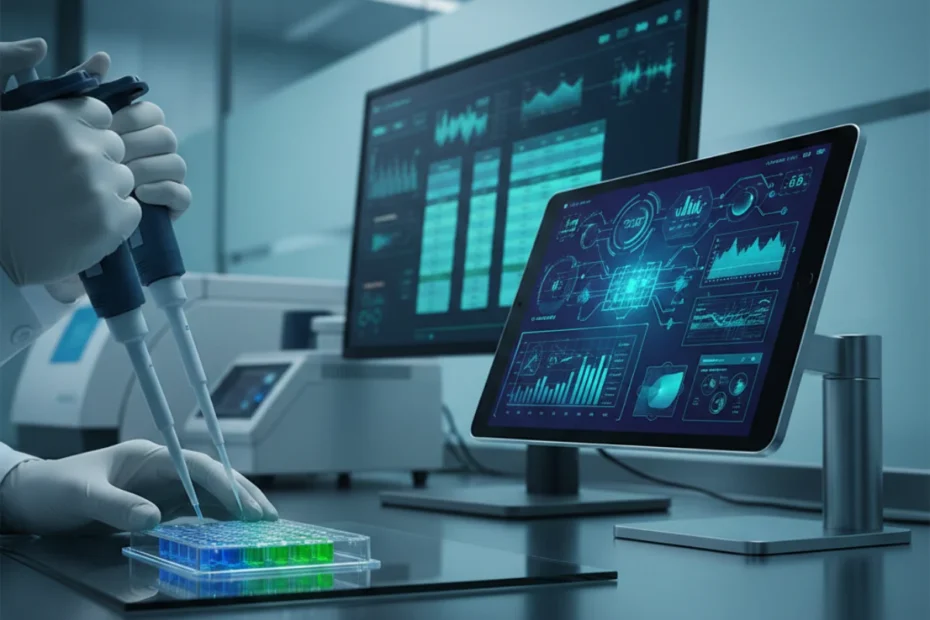
In laboratory research, particularly in high-throughput experiments such as PCR, ELISA, or drug screening, efficiently managing large datasets is crucial. For experiments involving 96-well plates, which can hold up to 96 individual samples per plate, the volume of data produced can quickly become overwhelming. Without a clear system for tracking results and managing data, researchers risk errors, inefficiencies, and the loss of critical information.
Accurate data tracking is essential to maintain data integrity and ensure reproducibility in experiments. With well-organized monitoring, you can confidently analyze and compare results from different experiments or trials. In this guide, we will explore best practices for organizing and managing data from 96-well plate experiments, from initial data collection to long-term storage and analysis. We’ll also highlight tools and software to streamline this process and ensure your experiments run smoothly.
What is a 96-Well Plate?
A 96-well plate is a standard laboratory tool used to conduct experiments involving multiple samples. It consists of 8 rows and 12 columns, totaling 96 wells, with each well capable of holding small volumes of liquid or sample material. These plates are widely used in high-throughput screening, PCR (Polymerase Chain Reaction), enzyme assays, ELISA (enzyme-linked immunosorbent assay), and other lab procedures that require testing multiple conditions or samples simultaneously.
Due to their efficiency in processing many samples at once, 96-well plates are essential for high-volume research. Each well’s contents can be tested and measured independently, making them an ideal choice for experiments that involve a large number of samples. In many cases, researchers use multiple plates for large-scale experiments, which generates large amounts of data that need to be tracked and managed carefully.
The Challenges of Data Collection
As experiments using 96-well plates can involve hundreds or thousands of data points (such as absorbance, fluorescence, or gene expression levels), the volume of data collected can quickly overwhelm a researcher or lab team. Accurate data collection becomes a challenge because:
- Manual data entry can introduce errors, especially when transferring results from instruments (like plate readers) into spreadsheets.
- High throughput means that data from multiple plates or assays may need to be tracked simultaneously, which can create confusion.
- Multiple measurements per well (e.g., at different time points or under other conditions) require careful organization to avoid data mismanagement.
Without a structured system for collecting, recording, and organizing data, these challenges can lead to inconsistent or even erroneous results, potentially jeopardizing an entire study.
Data Types in 96-Well Plate Experiments
Depending on the experiment, data from 96-well plates can be quantitative or qualitative. The 96-well plate layout is designed for consistency and efficiency, with 96 uniform wells arranged in an 8×12 grid. Understanding the types of data you’re working with will help guide your tracking and management strategies.
- Quantitative Data: This is the most common type of data collected in 96-well plate experiments. It includes fluorescence readings, absorbance values, or cell counts—all of which can be measured using plate readers or other lab instruments. These data points are often numeric and require precise recording for analysis.
- Qualitative Data: For some experiments, the data may be more descriptive, such as visual observations or categorical data, such as whether a reaction occurred or not. While this data is often less structured, it still needs to be carefully documented to ensure accuracy.
Best Practices for Organizing 96-Well Plate Data
Ensuring Data Accuracy: Data Validation and Quality Control
When managing data from 96-well plate experiments, accuracy is paramount. Even a small mistake in recording or analyzing data can lead to flawed results, compromising the entire study. To maintain high data integrity, it is essential to implement strict data validation and quality control (QC) measures throughout the experiment.
Data Validation Techniques
Data validation ensures that data entered into the system or spreadsheet is correct, complete, and properly formatted. This helps prevent human errors that can occur during manual entry. Here are several ways to validate your data:
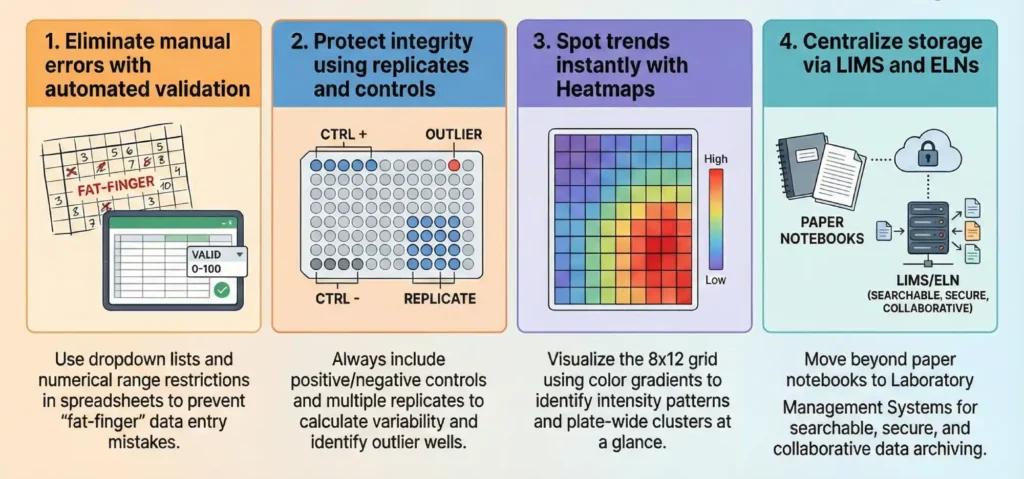
- Data Entry Restrictions: When using tools like Excel or Google Sheets, you can set up data validation rules to restrict input to certain values or formats. For example, you can ensure that only numeric values are entered into specific columns or that sample IDs match predefined formats.
- Dropdown Lists: Using dropdown lists in spreadsheets can also minimize data entry errors by limiting the available choices to predefined options. This is particularly useful when entering categorical data such as experimental conditions, sample types, or reagent names.
- Automatic Range Checks: For quantitative data, it’s essential to ensure that values fall within a reasonable range. For example, you can set up automatic checks in Excel to flag any absorbance values that fall outside of the expected range.
Quality Control Checks
Quality control involves reviewing data to ensure it meets predefined standards and identifying potential sources of error. Here’s how you can implement QC during a 96-well plate experiment:
- Replicates and Controls: Replicates and controls are essential in identifying outliers and ensuring the accuracy of your results. Always include positive and negative controls on your plate, as well as multiple replicates for each experimental condition. By comparing results across replicates, you can assess variability and ensure that your results are consistent.
- Plate Reader Calibration: Ensure that your plate reader is regularly calibrated to avoid systematic errors in measurements. Plate readers should be checked at the start of each experiment to confirm their accuracy. Miscalibrated instruments can skew all subsequent readings, leading to unreliable data.
- Statistical Methods for QC: You can use statistical methods, such as standard deviation (SD) and coefficient of variation (CV), to monitor data consistency. High variability across replicates may signal issues with the experiment, such as inconsistent sample handling or instrument malfunction.
By implementing robust data validation and quality control procedures, you reduce the likelihood of errors and ensure that your data remains reliable and accurate.
Best Practices for Data Visualization
Once data from a 96-well plate experiment has been collected and validated, the next step is data visualization. Visualizing experimental data is crucial for interpreting complex datasets and communicating findings clearly. Well-designed visualizations allow researchers to spot trends, compare different conditions, and summarize results in a way that is easy to understand.
Choosing the Right Visualization Tool
There are several tools available for visualizing 96-well plate data, depending on the complexity of the experiment and the level of detail required:
- Excel: Excel offers a variety of chart types (e.g., bar charts, scatter plots, line graphs) that are useful for basic data visualization. For example, you can plot absorbance readings over time to analyze the kinetics of an enzyme reaction or compare fluorescence readings from different experimental conditions.
- GraphPad Prism: GraphPad Prism is a powerful tool for data analysis and visualization, especially for biological research. It is widely used for generating publication-quality graphs and conducting statistical analysis. Prism is especially useful for dose-response curves, survival analysis, and other specialized assays.
- R: For more complex data analysis and visualization, R is an excellent programming language. It provides a wide array of statistical and graphical packages that can be used to create heatmaps, boxplots, or even custom visualizations to represent large datasets from 96-well plates.
Heatmaps for 96-Well Plate Results
One of the most popular ways to visualize data from 96-well plates is through heatmaps. Heatmaps are particularly useful in assays where you need to compare multiple experimental conditions simultaneously. For instance, in high-throughput screening, a heatmap can represent the level of activity in each well, with color gradients indicating intensity.
How to Create a Heatmap:
- Step 1: Collect and organize your data in a spreadsheet or statistical software (e.g., R or GraphPad).
- Step 2: Apply color scales to represent the data. For example, higher values might be shown in red, while lower values are shown in blue.
- Step 3: Visualize the data as a heatmap to easily identify trends, clusters, or areas with outlier values. This method is especially helpful when you’re looking for patterns across multiple conditions.
Graphing Data from Multiple Plates
When conducting large-scale experiments, researchers often need to compare data from several 96-well plates. Tools like Excel or GraphPad Prism can help you organize and graph data from multiple plates in one cohesive visual.
- Plotting Across Plates: You can group data from different plates by experimental condition and plot them in a single chart. This method allows you to track results from multiple plates and visualize how conditions affect the outcome across the entire experiment.
- Subgroup Comparisons: When comparing different experimental groups, bar graphs or box plots can be helpful to compare data points and assess variability between groups.
Using Statistical Analysis for Data Interpretation
For 96-well plate experiments, it’s often necessary to perform statistical analysis to determine the significance of your findings. The standard dimensions of 96 well plates are approximately 127.8 mm in length, 85.5 mm in width, and 14.4 mm in height. Statistical methods help to identify trends, assess variability, and compare experimental conditions.
Statistical Tools for Data Analysis
- T-Tests: Use t-tests to compare the means of two groups (e.g., control vs. treatment). This is particularly useful when comparing results across different experimental conditions.
- ANOVA: If you have multiple groups to compare, analysis of variance (ANOVA) can be used to test for significant differences across more than two groups.
- Regression Analysis: For dose-response studies or other continuous variables, regression analysis can help identify the relationship between variables and predict outcomes.
Interpreting Data Using P-Values and Confidence Intervals
When performing statistical analysis, p-values and confidence intervals (CIs) provide crucial information about the reliability of the results:
- P-Value: A low p-value (typically < 0.05) indicates that there is a statistically significant difference between groups, suggesting that the treatment or experimental condition had an effect.
- Confidence Interval: The CI provides a range of values that are likely to contain the true result. A narrow CI suggests higher precision, while a wide CI indicates more uncertainty in the estimate.
By combining effective data visualization with robust statistical analysis, you can extract meaningful insights from your 96-well plate data and ensure the accuracy of your findings.
Storing, Archiving, and Sharing 96-Well Plate Data
Digital Data Storage and Archiving
Storing and archiving experimental data from 96-well plates is critical for maintaining data integrity and ensuring future access. Long-term data storage solutions should be secure, accessible, and compliant with regulatory standards.
Cloud-Based Storage Solutions
Cloud-based services like Google Drive, Dropbox, and OneDrive offer excellent options for storing experimental data. These services allow you to securely store your data, access it remotely, and share it with collaborators in real-time.
Benefits of cloud storage:
- Accessibility: Access data from anywhere, enabling collaboration with remote team members.
- Security: Ensure data is stored securely with encryption and backup systems to prevent data loss.
- Version Control: Track changes and maintain multiple versions of your data files.
Backup Strategies
To prevent the loss of valuable data, it is essential to implement a regular backup strategy. Set up automatic backups for your digital data and keep redundant copies in separate locations (e.g., physical hard drives or alternative cloud storage services).
- Regular Backups: Schedule daily or weekly backups, depending on the frequency of data collection.
- Data Redundancy: Store backups in multiple locations (e.g., external hard drives, cloud services) to ensure data protection in the event of hardware failure.
Data Sharing and Collaboration
Data from 96-well plate experiments are often shared with colleagues and collaborators, or even published for public access. When sharing data, it’s essential to maintain data integrity and ensure that it’s presented clearly.
- Sharing Data with Collaborators
Cloud storage solutions make sharing data with team members straightforward. By setting permissions and sharing links, you can control who has access to your files while ensuring that collaborators can work with the most up-to-date version. - Archiving Data for Publication
If your data is to be published or included in publicly accessible research databases, ensure that it is well-organized and includes sufficient metadata to allow others to understand the experimental conditions and methodology.- Metadata: Include experimental details such as sample sizes, reagent concentrations, time points, and assay conditions.
- Data Formats: Use universally accepted file formats (e.g., CSV, Excel, PDF) for ease of access and reproducibility.
By properly storing, backing up, and sharing data, you ensure that your 96-well plate experiment data remains accessible, reproducible, and secure for future use.
Managing Large Datasets: Tools for Streamlining Data Storage and Retrieval
For large-scale 96-well plate experiments, efficiently managing and retrieving data is crucial. The more complex the experiment, the larger and more difficult the resulting datasets are to handle. To address this challenge, laboratories often rely on sophisticated tools and systems to organize, store, and retrieve experimental data.
Using LIMS for Data Management
LIMS (Laboratory Information Management Systems) are powerful tools for managing large volumes of experimental data. These systems provide centralized storage, tracking, and reporting features that integrate seamlessly with other laboratory systems. For 96-well plate experiments, LIMS can:
- Track Sample Information: Automatically associate sample information with experimental results. This ensures that data from each well or plate is linked to the correct sample and condition.
- Facilitate Data Retrieval: With LIMS, researchers can quickly retrieve experimental results based on specific search criteria (e.g., experiment type, date, reagent used).
- Manage Large Datasets: LIMS can handle large datasets, such as the hundreds of data points generated by 96-well plates, and provide real-time updates on experiment status.
By implementing a LIMS, labs can streamline data collection, analysis, and archiving, reducing manual handling and minimizing errors.
Utilizing ELNs (Electronic Lab Notebooks)
ELNs (Electronic Lab Notebooks) are another tool commonly used in research laboratories to document experimental procedures and results digitally. ELNs facilitate data entry, storage, and retrieval, and they provide several benefits:
- Secure Data Storage: ELNs allow researchers to store data securely in digital format, ensuring it is not lost or damaged as it might be in paper notebooks.
- Searchable Records: Unlike paper notebooks, ELNs provide a fully searchable database of experimental records. This makes it easier to access previous experimental setups or data points from 96-well plate experiments.
- Collaboration: ELNs enable real-time collaboration among researchers. Multiple users can access and edit data simultaneously, and all changes are logged for transparency and tracking.
Streamlining the Data Sharing Process
Efficient data sharing requires that researchers standardize how data is presented and communicated. Using digital tools such as cloud storage, LIMS, and ELNs makes sharing 96-well plate data much more seamless. Here are a few additional strategies for streamlining the process:
- Data Templates: Create standardized data templates (e.g., Excel sheets or LIMS formats) for collecting and sharing results. Templates ensure consistency across experiments and make it easier for collaborators to interpret and use the data.
- Data Synchronization: Use platforms that allow automatic synchronization between data entry systems and analysis tools, so data can be updated and analyzed in real-time without manual intervention.
These strategies help reduce the time spent transferring data between systems and people, ultimately speeding up research workflows and improving collaboration.
Conclusion: Optimizing Data Management in 96-Well Plate Experiments
Effectively tracking results and managing data from 96-well plate experiments is essential to ensure your research is reproducible, accurate, and transparent. By adopting best practices for data collection, validation, and visualization, and using the right tools for storage and collaboration, you can streamline your workflow and avoid costly errors. Tools like LIMS, ELNs, and cloud storage solutions will help you stay organized and maintain data integrity throughout your experiment.
As the amount of data generated in modern laboratories continues to grow, especially with high-throughput techniques such as 96-well plate assays, it’s crucial to invest in efficient data management systems. Doing so will not only enhance the quality of your research but also improve collaboration, reproducibility, and the overall success of your experiments.